People often ask where to buy fruit and nut trees from. You can easily pick up Meyer lemons, Tahitian limes, lemons, mini dwarf trees to be kept in pots, and all manner of berries from Home Hardware in Katoomba. Along the highway in Faulconbridge the Fruit Shop there also sells trees. Oranges, lemons and other young trees available in post, around $30 each last time I looked, as well as herbs for companion planting. I picked up a variegated cumquat from another place just off the highway the other way, on route to Hartley, this was a particularly lucky find, there being almost no other fruit trees available there.
Be aware that even local shops will sell plants and trees which may not grow in your yard as the climate changes so much from one end of the mountains to another. So it makes sense to do a bit of research first (see our list of what grows where) and talk to the staff if you're still not sure, before you suffer the lost of a tree (heartbreaking!).
If you're looking for a wider variety, and heritage trees for, then mail order is your best bet.
Up north, in warmer climes, Forbidden Fruits have everything from Acerola Cherry (Malpighia emarginata) Midyim berry(Austromytus dulcis) to the humungous White Sapote.
Daleys Fruit Trees based in northern NSW have a terrific selection and heaps of buyers contribute to a community forum with lots of growing experiences shared. They also offer trees especially for container growing and at the other end of the scale, have a wholesale option for those of you looking to establish larger orchards.
Upper mountains residents in our cool climate may prefer to buy trees from similar cooler climates which need less acclimatisation on delivery to our mountain heights.
Woodbridge Fruit Trees is where all the heritage apple trees down at Katoomba Community Gardens came from over 20 years ago, and all but one still going strong. You can buy trees 'bare rooted' without soil attached and therefore less shipping costs from them in mid-winter mid July-August. They stock dwarf trees, crab apples, plums, apricots and quinces & 'step over' apples for those of use packing a lot of fruit into smaller spaces. Check out their guide to pollination to make sure of good productivity.
Pete the Permie is brimming with passion and knowledge about fruit trees, and on his site you can find excellent information about the range of different rootstocks something not well or easily explained elsewhere. Although based in Victoria and not inclined to post trees unless absolutely necessary, he will be travelling around a bit in Winter so pick ups can be arranged.
Yalca Fruit Trees also in Victoria, delivering July/August stock a large range of fruit and nut trees including quite an extensive range of figs and ballerina apples (grow in one column).
Diggers, also based in Victoria, are perhaps better known for open pollinated seeds also sell a wide variety of heritage fruit and nut trees. The community gardens' pear trees planted there in the shelter of a long established hazel hedge in the community gardens are doing well. They also supply various 'collections' which ensure you have the right trees for pollination and/or supply with fruit throughout the season with early mid and late cropping varieties.
If you know of fruit tree sellers who should be added to this list please get in touch with the Fruit and Nut Tree Network via edibleforests@gmail.com
Tuesday, June 17, 2014


Tuesday, April 8, 2014
Autumn News: Jams at the ready!
Find ideas and events for Autumn and Winter, an outstanding saffron milk cap recipe, the Great Chestnut Challenge at Leura Harvest Festival in May, how to find the tastiest Apples and more all in the latest Fruit and Nut Tree Network Autumn/Winter Newsletter.
Now Leura Harvest Festival is a calling for your tastiest jams! If you're feeling a little confident about your jam making this year, or just want to find out what jams others are creating, then this is the competition for you.

Now Leura Harvest Festival is a calling for your tastiest jams! If you're feeling a little confident about your jam making this year, or just want to find out what jams others are creating, then this is the competition for you.
Who really makes the tastiest jam in all the mountains?
We're delighted to see that this festival in May celebrating local produce, producers and providores and they're particularly welcoming local food initiatives, so if you've something to share or sell, and would like to book a stall contact the festival co-ordinator Lisa Doust on 0400 176 005 or email lisadoust@internode.on.net
Monday, March 3, 2014
fruit file: Katoomba Plum Jam
by Cressida Hall

In my backyard is the most self-sufficient tree of all time. A plum of some description with dark flesh and lovely weeping branches. I do nothing to it. I don’t prune it, water it, or fertilise it. All I do is ignore it. As thanks it fruits abundantly each year. I remember it only when cajoling currawongs and screeching sulphur crested yobbos take up residence in its upper branches. The riot in my backyard tells me it’s time to harvest. Overcome with ennui I continue to ignore it letting the plums fall and the birds plunder. It seems a shame and a waste but what would I do with all those plums anyway?
While I assiduously ignore the tree my friend, Kat, has been keeping a weather eye on it. One evening she takes my giant laundry basket, braving knee high grass, and fills it overflowing with plums. The fruit sits on my kitchen bench ripening and reproving me. I hand out a few bags of squishy plums to family and friends but the volume seems undiminished. There’s only one answer I’ll have to make jam. The giant bottles of savoury plum sauce I made several years ago still languish in my pantry, so this year I’ll go over to the sweet side.
Pickling, bottling and jamming all interest me. I love them in theory, I read recipes in books and online, but I am woefully short on actual jam making experience. I consult Pam the Jam, author of the River Cottage book on preserving. She has a fairly basic recipe for plum jam – just plums and sugar. I decide that this can be improved on so I set to work on creating plum, orange and star anise jam. I cut, weigh and boil fruit and sugar to Pam’s instructions. But I add orange juice and carefully counted strips of zest and star anise. I put the fruit on to cook, slowly. But I’m overly cautious, Pam says that the jam will reach setting point in 10 – 15 minutes. Thirty minutes, then forty minutes drag by, the house is filled with a sweet spicy aroma, but still the thermometer and plate in the freezer tell me the jam’s not set. Bored (and a little worried) I up the temperature to a rollicking boil and in 10 minutes I’m there – 104°C with a positive crinkle test. My jam will set. I fill hot sterilized jars with warm sweet jam wishing I wasn’t making such a mess.
I’ve made kilos of jam, filling jars I’ve been hoarding in the room of doom for years. I don’t really eat jam so I promptly start giving it away. It feels nice to give a gift I’ve cooked from my own produce. I’m happy. My friends are happy. I decide that maybe next year I’ll show the tree a little tenderness, but with my black thumbs that might not be a good idea.
Wednesday, January 8, 2014
Making Wild Cider
There have been a lot of windfall apples this summer in Katoomba. A few big gusts when the apples are ripe is all it takes, and the community gardens has a whole heritage apple walk full of trees, so the faintest waft brings down a whole fruitbowl full. So over Christmas when the winds blew and the rain came, apples came along with it.

When suddenly faced with kilos and kilos of not entirely perfect apples there’s really only one thing left to do. MAKE CIDER
I rope in a couple of friends, and being 21st century pioneers, we follow instructions from the interwebs. We find many experts in the world of ferment online, and within that vast collective, some who seem passionate as well as thorough in their reporting of the process to earn them the title in our conversation as “proper cider geeks”. And so it is, that we (that’s me and my cider drinking chums) take the ‘one in seven chance’ that all the work we put into juicing may produce something which we can’t actually drink by following their instructions.
Why do this? Well there are yeasts out there in the wild in the air and which live on the apples themselves, its these guys we’d like to employ here. Most cider you buy in the shops is made by first zapping the local yeasts on the fruit and then introducing predictable cider producing yeast. We could do that but then we’d have non local yeast and not very complex flavours, and it would definitely work (where's the fun in that?). We’re putting our windfalls in the hands of the locals so if good yeasts make it out on top in this ecosystem, then we’ll have a truly local cider with interesting, complex flavours as a result. We may even feel confident enough to do it again. We have minimised the risk of introducing other bacterium by sterilising our equipment first, and hope that our diverse apple community brings with it some strong and healthy yeasts to produce a human friendly ferment.
The normal way to make cider is to crush the apples and then press them. However, unable to find a cider press locally at short notice (if you have one there are apples galore still to process, so please get in touch) a friend kindly offers the use not one but two juicers.
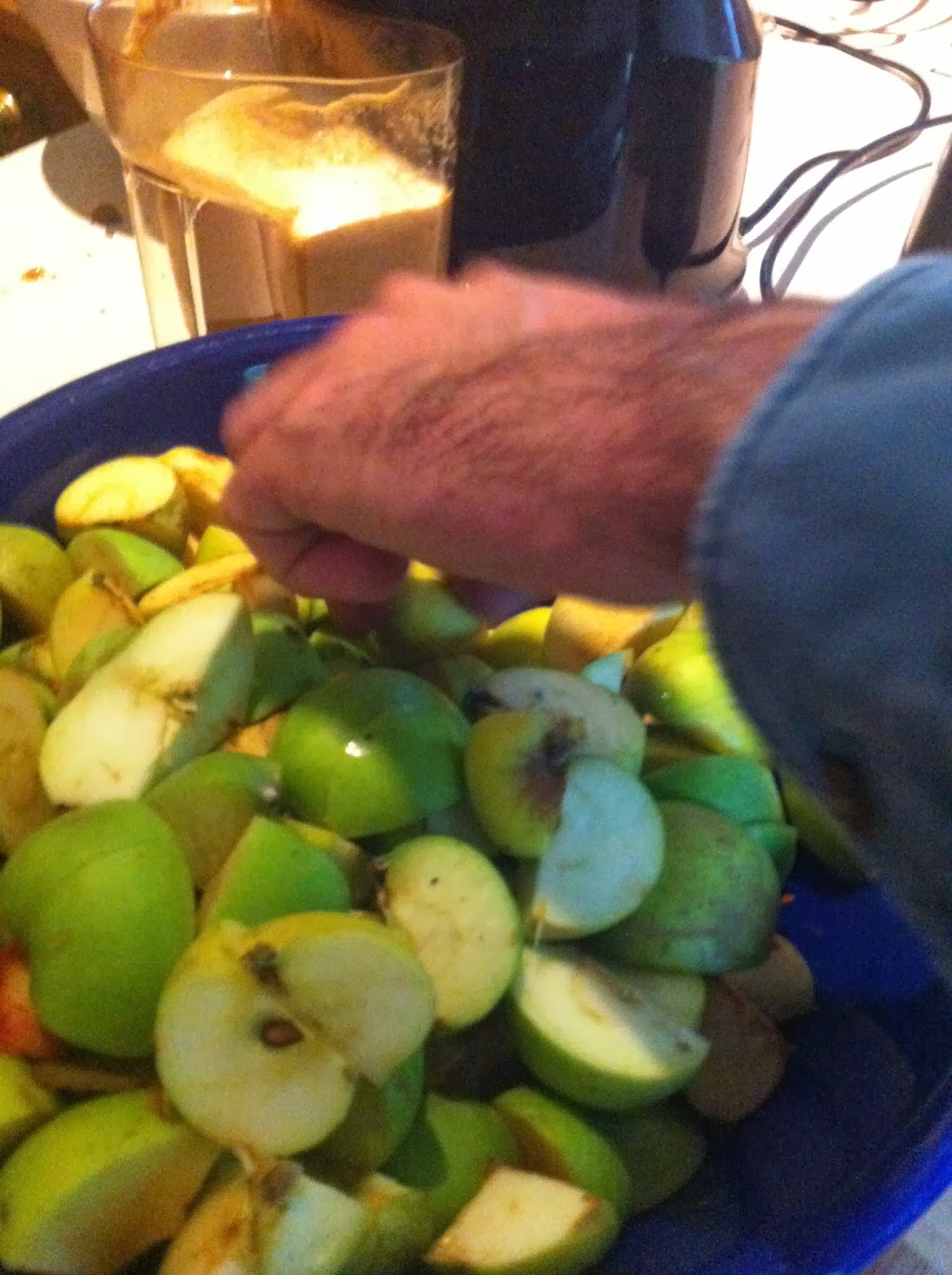


It’s not the same as crushing and pressing, but it is what’s on offer, so in the grand spirit of necessity being the mother of cider invention, off we go. We arrive at the house of juicers with two large and very strong reusable shopping bags full of apples. Two masticating juicers (these have slow rotating blades which emulate a chewing action to liberate maximum juice), chopping boards and knives are laid out at the ready, and our task is all the swifter for it.


Much chopping and juicing ensues. We stop to allow both juicers to cool down a couple of times from our mammoth effort, and within 2 hours (tea break not included) we’ve cut off the very bad bits, and chopped and juiced 33 kilos of windfalls. Our haul produces around 15 litres of juice which we pour into a fermenter pail for a first fermentation.
About 5cm of solid foam forms on top which we scoop off. Because we make beer at home we also have a hydrometer, we take a reading and it comes in around 1.044, which is a little lower than the recommended density, so if it works this cider probably will be relatively sweet. We test the juice at this stage, which is sharp, acidic and very very appley.
 |
| yes, it's quite hard to get a reading |
Now we just have to wait. Primary fermentation takes 1-2 weeks. I’ll post and update and let you know how it goes. And if you make cider from apples let us know how you make yours, do you crush and press, or juice?
There are plenty of apples to ripen still, come down to the community gardens on a Friday morning at 10am if you'd like to arrange to take some apples and try a cider making experiment yourself :-)
There are plenty of apples to ripen still, come down to the community gardens on a Friday morning at 10am if you'd like to arrange to take some apples and try a cider making experiment yourself :-)
Monday, December 16, 2013
24 hours in a food forest
by Sue Girard
This term TAFE Outreach and the Fruit and Nut Tree Network presented not one but two sets of workshops Food Forests at the Katoomba's Organic Community Gardens.
Over a dozen eager students from the Blue Mountains and just beyond, fronted up to find out what is involved in creating a Food Forest and how you would maintain one right here in this Temperate and Cool Mountainous climate.

Through the course, students explored how an immature woodland could be the most productive type of forest in providing fruit and nuts for people to consume. Together we looked at what would help trees grow and how to develop an ideal ecosystem to keep them in good health.
We planted nitrogen fixing seeds as well as longer lasting plants down near the citrus grove, not only to improve soil fertility but also to create a wind break from our late winter winds. We also rejuvenated the understory of herb and ground covers below the heritage apple tree walk in an endeavour to boost the productivity in that area. Intricacies of chill hours and incompatible flowers were just a few of the topics touched upon including pests and pruning. We found juvenile ladybeetles (good guys) and wooly aphids (bad guys) but fortunately no snakes, considering the suitable weather.

We planted nitrogen fixing seeds as well as longer lasting plants down near the citrus grove, not only to improve soil fertility but also to create a wind break from our late winter winds. We also rejuvenated the understory of herb and ground covers below the heritage apple tree walk in an endeavour to boost the productivity in that area. Intricacies of chill hours and incompatible flowers were just a few of the topics touched upon including pests and pruning. We found juvenile ladybeetles (good guys) and wooly aphids (bad guys) but fortunately no snakes, considering the suitable weather.

The students reported that they loved the interaction with the garden, and the informal – non classroom feel of the learning structure. Several expressed a wish to continue similar courses with TAFE and are hopeful such community engagement with TAFE will continue well after the financial year 2014.
Big thank you to everyone who came along, learning to help develop a food forest, and helping one mountains food forest grow.

Thursday, August 15, 2013
Free Food Forest course coming to Katoomba in October
It's been in the making over winter, and finally The Fruit and Nut Tree Network is excited to announce a great new course to help you create and maintain a wonderful productive food forest, and best of all its totally FREE.
If you're thinking about creating a forest of food from scratch, or considering retrofitting an existing orchard or stand of trees, or adding trees to a mature garden it can be hard to know where to start. How do you design to create a harmonious environment for beneficial and productive plants, and discourage pests and disease? You'll find out the answers to such thorny questions as these, and much much more.
Whether you're starting off in in 2 square meters or overhauling two hectares, many of the same strategies apply. Our upcoming free course in association with TAFE and the blue mountains community gardens in Katoomba will help you on your way.
Phone Denise on 4753 2039 or email bmoutreach@tafensw.edu.au to secure your place.

If you're thinking about creating a forest of food from scratch, or considering retrofitting an existing orchard or stand of trees, or adding trees to a mature garden it can be hard to know where to start. How do you design to create a harmonious environment for beneficial and productive plants, and discourage pests and disease? You'll find out the answers to such thorny questions as these, and much much more.
- How much room does a tree need? Won't I overcrowd it by underplanting?
- can I feed different fruit trees without buying specialised fertilisers?
- Will fruit be carried and spread into the bush?
- Are there any trees you shouldn't plant under?
- Do fruit trees all need pollinating by other trees?
- How much care, attention food air light & water do all these extra plants need?
Whether you're starting off in in 2 square meters or overhauling two hectares, many of the same strategies apply. Our upcoming free course in association with TAFE and the blue mountains community gardens in Katoomba will help you on your way.
Phone Denise on 4753 2039 or email bmoutreach@tafensw.edu.au to secure your place.

Monday, June 3, 2013
Food Dehydrating forum
What do you do when you have a state of the art food dehydrator and you don’t really know what to do with it?
Where do you start? What’s possible? What works well and not so well? What are the tricks? The answer is, you tap into the wealth of skills and knowledge that already exist in the community and bring it together within a FOOD DEHYDRATING FORUM.

That’s exactly what a member of the Fruit and Nut Tree Network did on Saturday June 1st. About fifteen women (no men put their hand up?) gathered in a cosy Leura home and pooled their knowledge regarding the dehydration of food. Some women had been doing it all their lives, following in family traditions, while others got into it through bush walking and outdoor activities. Most wanted ways to preserve seasonal fruits and veges either from their own garden abundance or from seasonal shop/farm gate offerings.

The group learned about making leather strips of fruit or veges, the ins and outs of meat jerky, fabulous and easy ways of dehydrating and re-hydrating whole dinners, semi dried tomatoes that start off reducing on a hot car bonnet, drying herbs, making yogurt and tips on reducing sauces/spreads to powders that reconstitute into things like tomato soup/paste, humus, babaganoush or an infinite number of other sauces that can be quickly added to dishes to boost nutrition and flavour.


Examples of dried foods were available to see/taste and one participant leaned that you must first blanch sweet potato rounds if you want them to result in really crispy yummy chips post dehydrating. Safe storage was also explored - plastic, glass or vacuum sealed bags and there were several brands of machines and cutting equipment on display to aid in future purchases.
All in all, it was exhilarating and inspiring and the best possible way to spend a cold cloudy winter’s day. The beginner dehydrators swam in a pool of tried and true knowledge while the experienced picked up further tips and recipes along with the satisfaction of sharing their skills. If there is sufficient interest, the forum could be run again next year.
Where do you start? What’s possible? What works well and not so well? What are the tricks? The answer is, you tap into the wealth of skills and knowledge that already exist in the community and bring it together within a FOOD DEHYDRATING FORUM.


The group learned about making leather strips of fruit or veges, the ins and outs of meat jerky, fabulous and easy ways of dehydrating and re-hydrating whole dinners, semi dried tomatoes that start off reducing on a hot car bonnet, drying herbs, making yogurt and tips on reducing sauces/spreads to powders that reconstitute into things like tomato soup/paste, humus, babaganoush or an infinite number of other sauces that can be quickly added to dishes to boost nutrition and flavour.


Examples of dried foods were available to see/taste and one participant leaned that you must first blanch sweet potato rounds if you want them to result in really crispy yummy chips post dehydrating. Safe storage was also explored - plastic, glass or vacuum sealed bags and there were several brands of machines and cutting equipment on display to aid in future purchases.
All in all, it was exhilarating and inspiring and the best possible way to spend a cold cloudy winter’s day. The beginner dehydrators swam in a pool of tried and true knowledge while the experienced picked up further tips and recipes along with the satisfaction of sharing their skills. If there is sufficient interest, the forum could be run again next year.
Monday, May 6, 2013
Chestnuts roasting in a woodfired outdoor oven
Fabulous chestnuts brought from Mt Irvine and Mt Tomah took centre stage at the weekend's permaculture day celebrations at the community Garden. Both seemed yielded their creamy sweet nutty centres easily, sliding from the shells when expertly cooked in this traditional chestnut roasting pan. You can always roast chestnuts in the oven too, and that's a great way to heat the kitchen as the temperature drops. I noted chestnuts from Bathurst at the co-op last Friday but I suspect we won't see too many more of these from local sources now. Remember fresh chestnuts don't keep for long even in the fridge.

A this time of year, the risk of frosty nights and cold winds increase, remember to protect any young citrus trees with a hessian or shade cloth wrapped securly around garden stakes as a tent (those under 3 years).
Saturday, May 4, 2013
Medlar: The Fruit of Misunderstanding
by Melanie and Alexander
The medlar is no ordinary fruit; it has inspired reverence and revulsion because of its obscure ripening process. The centre of a medlar flower invites curiosity and introspection. Flirtatious stigmas and stamens reflect the self-fertilizing nonchalance of a fruit which is edible when it borders on rotting. As the medlar fruit matures on the tree it resembles an apple with a crown at its bottom.  Its nether region is the source of risqué references in literature, including this one from William Shakespeare’s Romeo and Juliet (II, 1, 34-38):
"Now will he sit under a medlar tree,
And wish his mistress were that kind of fruit
As maids call medlars, when they laugh alone.
O Romeo, that she were, O that she were
An open-arse and thou a poperin pear!"
They are said to be “A fruit that ripens through its own corruption”.
Medlar is related to quinces and apples, and part of the rose family. Medlar trees grow very
slowly to 10 to 25 feet tall (3 to 7.5 metres), with a spread of 7 to 15 feet (2 to 4 1/2 metres.)
The wood of the tree is light red and very hard with a very fine grain; it was often used for
canes and walking sticks. The trees will start bearing fruit after 4 to 6 years, and are very long
lived. The leaves are long and pointed with hairs underneath them.
The trees bloom a month later than apple trees, producing pinky-white flowers. The fruit is
small and round. It starts off with greenish-yellow skin ripening to rust coloured. There is an indent at the top of the fruit, and several seeds inside.
The fruit is picked in the autumn when the leaves start to fall off the tree. You pick them right
after the first frost, when they are still hard. At this stage, they are not only too hard to eat;
they are also too sour to eat. The fruit needs to rot a bit first (this is called "bletting") before it
is actually considered "ripe" enough to eat. This takes about 2 to 3 weeks in storage. They will
become soft, mooshy brown, sweet and tasty with a flavour close to applesauce or cider. If
the word "rot" is too indelicate, you could always say that they need to mature, like a wine or
cheese.
“Bletting,” permits the breakdown of starches into sugars. As the flesh softens the inside of a
medlar begins to resemble applesauce. It is precisely at this time that notes of cider, spice
and the musk of ripe apricots develops. There is short window of time between edible and
rotten, which has led to adoration by connoisseurs and disgust by those who cannot contend
with the medlar’s fermentation. The fruit is more tenacious than those who have no patience
for its obscurity. In addition to being self-pollinating the medlar can set fruit without
pollination—nature’s reckoning for those who misunderstand this amazing fruit.
Medlars may be eaten raw, cooked or baked. Jellies are commonly made as the fruit is
naturally rich in pectin. Medlar varieties include: Dutch, Macrocarpa, Nottingham and Royal.
Nottingham fruits are about 1 inch (2.5 cm) wide. The Dutch and Macrocarpa have somewhat
larger fruit.
Recipes:
MEDLAR CHEESE (An old recipe!)
Put some Medlars into an earthenware jar, stand it in a saucepan with boiling water nearly to
the top and keep it boiling gently over a slow fire. When the Medlars are quite soft, pass them
through a fine hair sieve, and weigh the pulp, and for every pound allow one and a half
breakfast cups of coarsely crushed loaf sugar and half a teaspoonful of allspice. Put all the
ingredients together in the preserving pan, and stir them over the fire with a wooden spoon
until thickly reduced, skimming occasionally. Turn the cheese into moulds, and keep them in a
cold place. When ready to serve, turn the cheeses out of the moulds on to a dish.
From Theodore Garrett The Encyclopaedia of Practical Cookery (London 1880)
MEDLAR CHEESE (A modern translation)
Put some Medlars into a Pyrex bowl, stand it in a saucepan with boiling water nearly to the
top and keep it boiling gently over a slow heat. When the Medlars are quite soft, pass them
through a fine sieve, and weigh the pulp, and for every pound allow one and a half breakfast
cups of coarsely crushed sugar and half a teaspoonful of allspice. Put all the ingredients
together in a preserving pan, and stir them over the heat with a wooden spoon until thickly
reduced, skimming occasionally. Turn the cheese into moulds, and keep them in a cold place.
When ready to serve, turn the cheeses out of the moulds on to a dish.
MEDLAR CHEESE (A Country Harvest Cookbook)
Equal weights of medlar pulp and sugar
1–2 oranges or 3-6 mandarins – juice and zest
Ground cloves
Stir pulp and sugar together in a pan, add the juice and zest of the oranges (or mandarins) to
taste.
Heat and cook, stirring constantly, until the pulp is thick and comes away from the sides of the
pan. Remove from heat.
Add cloves to taste and mix well. Pour into a buttered dish or tray. When dry, cut into
squares (can be sprinkled with sugar) and store in airtight containers with fresh bay leaves
between layers of baking paper. Serve as a sweetmeat with coffee or cheese.
MEDLAR JELLY (Method 1: Hugh Fearnley Whittingstall)
Ingredients
• 1kg medlars (quartered but not peeled)
• 500g Bramley cooking apples
• About 650g granulated sugar
1. Quarter the medlars. Peel and chop the apples and tip the fruit into a preserving pan, or
any heavy-bottomed, deep, wide pan, with just enough water to cover.
2. Bring to a simmer and cook for 30-45 minutes, until the medlars are soft and pulpy.
3. Strain through a jelly bag on a stand set over a large bowl. Don't be tempted to poke,
squeeze or force the pulp through the bag or you'll get a cloudy jelly, just leave it to drip over
the bowl for several hours or overnight. Don't discard the pulp though – it’s perfect for adding
to our chutney.
4. Measure the juice, pour into a clean preserving pan and bring to boiling point before adding
the sugar (for every 1l of juice, add 650g of sugar). Stir, in one direction only to reduce foam,
until sugar is totally dissolved then boil rapidly for 8 minutes or until the setting point is
reached. If you have a preserving thermometer, it should read 104.5°C; if you don’t have a
thermometer, drop a little jelly onto a saucer which you have chilled in the fridge. Let the jelly cool for a minute then push it gently with your finger. If it crinkles, it has reached its setting
point. Remove from the heat and skim off any scum using a slotted spoon.
5. Decant carefully into a warm jug and pour into warm, sterilised jars.
MEDLAR JELLY (Method 2: A Country Harvest cookbook)
Put soft, ripe medlars whole into a pan and just cover with water. Cook gently until the fruit is
pulpy. Place into a double layer of muslin, and hang over a basin so that the juice drips into
the basin. Leave overnight. Measure the liquid into a pan. Add 2 cups of sugar for every 2½
cups of juice. Heat, stirring until the sugar dissolves, then boil rapidly until the jelly sets when
tested. Pour into warm, sterilised jars.
MEDLAR PASTE
Sieve the pulp left in the muslin – this can be stored in the refrigerator and used in the recipes
below. It can also be sweetened to taste, maybe add some spices and/or citrus zest, and
used in smoothies, served with yoghurt or ice cream, stirred into porridge, etc.
MEDLAR AND APPLE CHUTNEY (Hugh Fearnley-Whittingstall)
Ingredients
• 3-4 tbsp sunflower oil
• 4 tbsp mustard seeds
• 2 tbsp crushed black peppercorns
• 1 tbsp fenugreek seeds
• 1 tbsp ground cumin
• 2 tsp turmeric
• 1 bulb of garlic, peeled and grated
• 5-7cm piece of fresh ginger, peeled and grated
• 6 fresh red chillies, deseeded and finely chopped
• 2kg Bramley apples, cored and chopped
• 500g dark Muscovado sugar
• 500ml cider vinegar
• 2 tbsp salt
• The left over pulp from the medlar jelly, or about 700g pears, peeled, cored and
chopped
Method:
1. Warm the oil in a large, heavy-bottomed saucepan over a medium heat and add the spices,
stirring well and frying until the mustard seeds just begin to pop. This will only take a minute
or so – be careful not to scorch the spices. Add the garlic, ginger and chillies, stir well, and fry
gently for few minutes.
2. Tip the chopped apples into a large preserving pan and pour over the spices.
3. Add the sugar, vinegar and salt, along with the left over pulp from the medlar jelly, or the
pears if you are using them instead.
4. Stir over a low heat until the sugar dissolves, then simmer for about 2 hours until thickened,
stirring occasionally and adding a little water if you think it’s beginning to look too thick.
5. Bottle in warm, sterilised jars, filling the jars really full as the mixture will shrink slightly as it
cools. Seal with vinegar-proof lids.
MEDLAR CAKE (A Country Harvest Cookbook)
½ cup butter
1 cup sugar
1 cup medlar pulp
½ -1 cup sultanas
1tsp bicarb
1tsp hot water
½ - 1tsp ground cloves
2 cups plain flour
Grated rind of 1 lemon or orange
¼ cup walnuts
Cream butter and sugar until smooth, and blend in the medlar pulp and sultanas.
Dissolve the bicarb in the hot water and add to the mixture.
Sift the cloves and flour and fold in with the grated rind.
Put into a greased tin and sprinkle with walnuts
Bake at 180C for 1 hour.
MEDLAR TART (A Country Harvest Cookbook – this is an old Elizabethan recipe))
“Take medlars that are rotten, strain them, and set them on a chaffing dish of coals, season
them with sugar, cinamon and ginger, put some yolks of eggs to them, let it boil a little, and
lay it in a cut tart; being baked scrape on sugar.”
Robert May The Accomplisht Cook 1660
Shortcrust pastry shell (use your favourite recipe)
Medlar pulp
Sugar to taste
Spices – ginger, cinnamon or cloves
Grated citrus peel
Egg yolks
Beat the pulp and egg yolks until thick and smooth. Blend in sugar and spice (amount to suit
your tastes), and grated citrus peel. Spoon into the pie shell and bake at 200C until the
pastry is brown and the filling set (depending on your oven, this should take about 30
minutes.
Variations: You can add some dried fruits (sultanas, glace peel, etc), or nuts. The egg
whites can be beaten to stiff peaks, sweetened with sugar, and piled on top before cooking to
make a medlar meringue pie.
MEDLAR FUDGE
Makes about 4lbs
- 2lbs medlars
- 2 small lemons
- 3 cloves
- 1pint apple cider
- 2lb light brown sugar
- Honey or maple syrup to taste, cream and macaroons to serve.
• Wash and chop fruit, add cloves and cider.
• Simmer until fruit is soft.
• Sieve and weigh the pulp.
• Add three quarters of its weight in sugar and bring back to boil, then bottle and seal.
• When required, whip the fruit cheese with honey or maple syrup until soft, spoon into
bowls and top with whipped cream and broken macaroons.
MEDLAR COMFITS (ELIZABETHAN RECIPE)
Medlars
Honey
Coriander
Cardamom
Ginger
Black Pepper
Butter
Squish the medlars, as many as you have or have patience to squish. (The stuff that's left
after you smoosh your medlars: Pour boiling water over it, and leave to cool. Strain through a
sieve and you have MEDLAR NECTAR.)
Put the pulp in a pan with a like amount of honey, e.g. 1/2 cup medlar to 1/2 cup of honey.
To that, put what seems like a ridiculous amount of spice, e.g. 1/2 teaspoon each of
coriander, cardamom, and ginger, and three freshly smashed peppercorns. Add your butter (a
walnut-sized blob).
Cook over medium heat, stirring all the while with a wooden spoon. It should seethe nicely in
no time, and thicken faster than it should, considering anything exotic should take several
hours. Consider it done when it parts to your spoon, falling back before you can say a twosyllable word. It will be satiny and pourable but not runny.
Pour into an oiled tray or dish to a depth that is as thick as you have patience for, because it
needs to dry. Put aside till it sets firm enough to do what you will with it, which may be two
days later, when it is rubbery enough to come away in one piece when lifted with a knife, but
still pliable enough to be rolled up without cracking.
To make these medlar comfits:
Cut into strips and roll up or cut into shapes (squares or diamonds are easiest). Put them on
waxed paper in a cardboard box. Leave for several weeks at least, not only for the
consistency to be firmer and chewier, but for the spices and honey to properly mellow.
These comfits are spectacularly good eaten with an accompaniment of walnuts. Serve also
with cheese, wine, and with coffee or hot chocolate.
MEDLAR WINE
8 lb / 3,600 grams Medlars
3 lb / 1,350 grams sugar
Pectin enzyme
Water up to 1 gallon
1/2 pint strong black tea
Campden tablet
Yeast nutrient
Wine yeast
Place the ripe fruit in a fermentation bucket and pour over the boiling water. Add 1 lb. of sugar
and an equal quantity of cold water. Add the campden tablet, pectin enzyme and yeast
nutrient and wine yeast. Cover and leave for three days in a warm place, stirring daily. Strain
through a fine sieve and add the rest of the sugar and put into a demijohn and fit an airlock to
seal the jar.
Store in a warm place and allow the fermentation to work. When fermentation has ceased,
rack the wine into a clean jar and place in a cooler environment and leave. When the wine is
clear and stable siphon into bottles.
Saturday, April 27, 2013
Preserving Traditions Winter Workshops
Hang on to that harvest for longer and the kitchen warmer in these delightful processes. Come along and learn how easy it is to fill those shelves with homegrown or foraged fruits. If you've a favorite ferment, ways with pickling or you're nuts about flours and want to share those skills, or you'd simply like to experiment with ways of storing & enhancing nutrition and flavours over winter, get in touch with the fruit and nut tree network via edibleforests@gmail.com


Friday, April 19, 2013
local produce this weekend at the co-op

Remember to look out too for free ingredients from fellow mountain fruits and nuts sharing their surplus, like these free curry leaves.
Saturday, April 13, 2013
Edible Plants for Sale in Clarendon at the Collectors' Plant Fair Today
 |
Grumichama |
With talks, plant stalls & refreshments this is easily a full day out. Sunday's talks begin with landscape gardener Michael Bligh on Edible Gardening in a more formal garden context in an eclectic schedule. Plant enthusiasts, garden geeks, books, accessories as well as plants you will rarely see elsewhere all feature at this friendly event.
$12 gets an adult through the turnstile, accompanying under 18's get in for free.
We're just there for a morning and so it's my chance to see what small productive plants I can find for my own garden and see the wider range of suppliers all in the one spot. With over 40 nurseries' stalls, it would be easy to be overwhelmed, so I checked out the list of nurseries selling edibles as a shortlist, within those stopping to explore those with whom I felt some accord in their plant selections. I picked up some more unusual herbs like caraway thyme at 5 for $15 at Four Seasons Herbs in Coffs Harbour. Bargain! Their stall includes certified organic garlic, saffron corms and even wasabi all at prices lower than advertised on their website. If you're as keen to seek out unusual fruits to keep fresh sources of vitamin C flowing throughout the year, peruse the offerings from Forbidden Fruits who have everything from Acerola Cherry (Malpighia emarginata) & Midyim berry (Austromytus dulcis) to the humungous White Sapote (Casimiroa edulis) tree, at up to 15m high its not one for my tiny backyard unfortunately!

If you discover this post a little later than 'in the nick of time' don't despair, many of the great plants suitable for fruit and nut tree growers are available at some participating nurseries on site or online for the rest of the year through nurseries represented at this event.
Visit nearby Secret Garden at the UWS Richmond campus who have an open day coming up in time for Permaculture Day weekend with Autumn Harvest on Saturday 4th May, or locally to our own Blue Mountains Community Gardens in North Katoomba also be open for plant sales on the morning of May 5th for International Permaculture Day. Online pleasures can be found at Forbidden Fruits with their formidable catalogue of unusual fruit, and Heaven in Earth displayed a fabulous range of low key, beautiful and useful gifts made from natural materials for you and your gardening friends. I'll also mention that the wonderfully helpful & friendly booksellers Florilegium carry a range of excellent books on edible gardening including the mighty Edible Forest Gardens volumes, online or in Glebe. Full list of nurseries at this special annual sale available here.
If you know of sales, swaps or events coming up through the year which would be of interest to budding or established food foresters, please leave a message here or drop a line to edibleforests@gmail.com and we'll include it in upcoming calendar notices and/or newsletters.
Monday, April 8, 2013
This week (8th April) at the Food Co-op local producers have brought in HEAPS: Quinces, figs, limes, apples, plums, chestnuts, beetroot, potatoes, beans, choy sum, chillies, parsley, basil, chives, rhubarb - see regular updates on their facebook page, share and swap with the Blue Mountains Foragers' Network and monthly in the mid mountains at Crop and Swap (next meeting April 13th)
Wednesday, March 27, 2013
April 6th: Dehydrating Food Workshop
Dehydrating Workshop on Saturday 6 April with Maggie
Dehydrating: Sucking the juice out of food. Or, in more techno speak, a food processing technique that extracts the moisture in foods, thereby inhibiting the growth of microorganisms facilitating the preservation of food for indefinite periods.
Dehydration is one of the oldest methods of food preservation – going back to prehistoric people who sun-dried seeds. At the workshop there will be no experts. Just a lot of folks sharing experiences.
Different styles of dehydrating machines will be on display as well as examples of delicious dehydrated food stuffs like: beef jerky, fruit and vege strips, as well as some surprises.
Did you know you can dehydrate soups and even complete meals?
So this workshop is perfect for everyone, no matter where you fall on the dehydrating experience scale.
Bring a little something to share for morning tea and it’s not necessary for it to have been dehydrated!
Please email/phone Maggie if you wish to attend for full address of workshop in Leura.
Hope to see you there. maggie53@aapt.net.au 4782 2441
 |
| hot chillies drying for later |
Dehydrating: Sucking the juice out of food. Or, in more techno speak, a food processing technique that extracts the moisture in foods, thereby inhibiting the growth of microorganisms facilitating the preservation of food for indefinite periods.
Dehydration is one of the oldest methods of food preservation – going back to prehistoric people who sun-dried seeds. At the workshop there will be no experts. Just a lot of folks sharing experiences.
Different styles of dehydrating machines will be on display as well as examples of delicious dehydrated food stuffs like: beef jerky, fruit and vege strips, as well as some surprises.
Did you know you can dehydrate soups and even complete meals?
So this workshop is perfect for everyone, no matter where you fall on the dehydrating experience scale.
Bring a little something to share for morning tea and it’s not necessary for it to have been dehydrated!
Please email/phone Maggie if you wish to attend for full address of workshop in Leura.
Hope to see you there. maggie53@aapt.net.au 4782 2441
Monday, January 21, 2013
Fruit and Nut Events Coming Up
A beautiful morning to meet up and organise events for the fruit and nut tree network at the Community Gardens in Harold Hodgson Park. Its still early enough in the day not to accumulate too many mosquito bites we meet to discuss what we might arrange over the summer months. And the outcome? We’re looking forward to delicious combinations of both planned and spontaneous activities based on what the seasons bring, and of course we hope you'll join us....
January 29th as network members know already, is the date for our popular Summer hands-on workshop: preserving with fowlers vacola with Anne Elliott - contact cloudlands@iinet.com.au to participate and create some beautiful jars of lovely fruit in this uniquely Australian tradition.
Find out more at the Slow Food website or see our post on the last session.
Summer brings so many fruits and this year is looking like a bumper crop all around, our friends at Todarello's Fruit market on the Bathurst Road, Katoomba will be letting us in on any super big spoils. Bruised fruit may not be acceptable for shoppers' fruit bowls at home, but they're great for preserving as jams, pickles and relishes. So throughout January and February, be on alert for news of fallen fruit jam and rescued relish making sessions which Anne will be hosting any morning there is such a surplus at 11am - FREE
Sunday February 16th - Love your trees this Valentine’s weekend, and find out all about Summer Fruit Tree Pruning in the mid mountains. Ben Gorrick (from Intree Solutions) will be running a masterclass on pruning - there will be the opportunity for lots of questions, and some guided hands-on practice. Kris has several established (and very overgrown) fruit trees (apricot, apple & pear); we’ll be turning these into ‘pedestrian’ height trees with the capacity to turn them into weeping habit to increase productivity. Contact Kris via email kris@cervelle.com.au or call 0458 626210 to arrange your spot in this workshop (and to help with catering for the refreshments :-) ).
Suggested donations to contribute: $10 waged, $5 unwaged.
In March we’ll be organising one of our calendar highlights gathering chestnuts in nearby Mt Irvine with Kookootonga Farm. We’re dependent on when the nuts are dropping, so sign up for updates or look out on the fruit and nut tree website to find out more.
Saturday April 6th The date for a dehydrating workshop - no experts. Just curious individuals who want to share helpful tips and information, ask questions and discover more about the diverse products you can make at home with a dehydrator. Bring all your experience to share or come as a beginner and see what it’s all about. - contact Maggie at maggie53@aapt.net.au if you’d like to attend. This event is FREE.
Next meeting of the fruit and nut tree network is: Sunday Feb. 24, 10 am at the Community Gardens in Katoomba. Bring (local) nibbles to share.
 |
| Anne, Kris, Jed, Rosie, Maggie and Sue |
January 29th as network members know already, is the date for our popular Summer hands-on workshop: preserving with fowlers vacola with Anne Elliott - contact cloudlands@iinet.com.au to participate and create some beautiful jars of lovely fruit in this uniquely Australian tradition.
Find out more at the Slow Food website or see our post on the last session.
Summer brings so many fruits and this year is looking like a bumper crop all around, our friends at Todarello's Fruit market on the Bathurst Road, Katoomba will be letting us in on any super big spoils. Bruised fruit may not be acceptable for shoppers' fruit bowls at home, but they're great for preserving as jams, pickles and relishes. So throughout January and February, be on alert for news of fallen fruit jam and rescued relish making sessions which Anne will be hosting any morning there is such a surplus at 11am - FREE
Sunday February 16th - Love your trees this Valentine’s weekend, and find out all about Summer Fruit Tree Pruning in the mid mountains. Ben Gorrick (from Intree Solutions) will be running a masterclass on pruning - there will be the opportunity for lots of questions, and some guided hands-on practice. Kris has several established (and very overgrown) fruit trees (apricot, apple & pear); we’ll be turning these into ‘pedestrian’ height trees with the capacity to turn them into weeping habit to increase productivity. Contact Kris via email kris@cervelle.com.au or call 0458 626210 to arrange your spot in this workshop (and to help with catering for the refreshments :-) ).
Suggested donations to contribute: $10 waged, $5 unwaged.
In March we’ll be organising one of our calendar highlights gathering chestnuts in nearby Mt Irvine with Kookootonga Farm. We’re dependent on when the nuts are dropping, so sign up for updates or look out on the fruit and nut tree website to find out more.
Saturday April 6th The date for a dehydrating workshop - no experts. Just curious individuals who want to share helpful tips and information, ask questions and discover more about the diverse products you can make at home with a dehydrator. Bring all your experience to share or come as a beginner and see what it’s all about. - contact Maggie at maggie53@aapt.net.au if you’d like to attend. This event is FREE.
Next meeting of the fruit and nut tree network is: Sunday Feb. 24, 10 am at the Community Gardens in Katoomba. Bring (local) nibbles to share.
Tuesday, November 27, 2012
PLENTY OF GREEN THUMBS AT FESTIVAL OF THE GREEN
27 October, Springwood Public School
by Anne Elliott
by Anne Elliott

It was most satisfying for Slow Food Blue Mountains and the BM Fruit and Nut Tree Network to be involved with this Festival. Hard to imagine that a very hardworking P & C of 5 people organised this event! So many hands-on activities covering worm farming, no dig gardening (with guest "verge garden king "and tv presenter Costa Georgiadis, making a special guest appearance) - to raising backyard chickens.
The whole school was taken over with activities, with scarecrows as direction points. There was even an 'eat street' and numerous stalls featuring handmade and locally-made. The scarecrow competition had some exciting entries, and the waste to art was also popular. Our stall consisted of information on Slow Food, and the BM Fruit and Nut Tree Network as well as the first of our Hands-on 'Cooking From Scatch' activities at local festivals, using local/rescued/bulk food. We invited Festival participants to make their own muesli from scratch, featuring bulk, organic ingredients from the Blue Mountains Food Coop. There was also educational material available (and taste-testing!) on healthy sugar-free alternatives such as xylitol, which is available in bulk from the Food Coop.
It was also heartening to learn just how many people are now 'growing their own' , and have embraced kitchen gardens in all their different formats. A number of people also added their details to our Fruit and Nut Tree Network enewsletter in order to keep in touch with Fruit and Nut Tree activities.
Monday, November 12, 2012
Notes from the Apple Orchards of Mustang
by Brian Coates
Central Asia is the crucible of many stone and pome fruit ecosystems. Most notably quince, pomegranate, apricot and pear. The origin of the apple is uncertain but it is most likely Western China.
We were fortunate this year to go treking in Northern Nepal to a region called Mustang which is famed for its apple orchards. Interestingly no other fruit trees are grown apart from the occasional apricot but Mustang has a lot of apples.
Mustang is a high cold desert with characteristics of high radiation, low precipitation, low soil nutrients and low temperatures. It is cut by the Kali Gandaki river gorge which supplies most of the water and soil nutrient. High desert regions along river valleys allow high hours of sun, soil nutrient, water and chilling hours for setting of fruit.
The apple orchards however are often located on the high ground above the river where the soil is rocky and sandy and water supply is supplied by snow melt from the high mountains.To see apples thriving in sandy rocky ground with high soil drainage,hot summer sun and no mulch or ground cover only to be surrounded by stone walls 2M high made me think how tough they must be. The only protective factor is wind protection. There is also the added advantage of very few birds !!
 |
| Apple Trees in Mustang - Manoj Adhikari |
In most orchards however, companion vegetables are grown such as beans/peas to provide nitrogen and cabbages to attract and absorb pests. Interestingly there was often a dead apple tree with an underplanting of tomatoes !!! Tomatoes are obviously toxic to apples.
Having said all this, the apple tree is a tough old thing and in my experience it resents being over cared for. So long as soil is very well drained, tree protected from hot strong winds, a steady supply of water via some sort of slow drip irrigation and a good companion planting arrangement should see the apple tree do well in the Blue Mtns. For bird protection grow as a tight hedging arrangement.
Tuesday, October 30, 2012
Meeting about continuing and expanding our network
We invite you to a meeting on Sunday 25 November, at 10.30 am at Cloudlands, 6 Banksia Park Road in Katoomba, to discuss how to continue and expand the BM Fruit and Nut Tree Network. Since its rejuvenation a few years ago, Anitra has been the key contact point for the network. Earlier this year, while Anitra was overseas, Kat Szuminska filled that role. Although Anitra returned late in July, she plans to move interstate (back to Victoria) in the near future. The role is already too much for one person so we need to work out ways to keep the network operating and to expand it.
This meeting will explore different ways that the network can operate. We're particularly interested in hearing from people who can invest time themselves but good ideas are welcome too. One idea is to have more sub-regional nodes, activities which rotate round the upper mountains, lower mountains and mid mountains. Up till now the network has been upper mountains centric simply because more people there have been prepared to offer time to activities there. We have more community gardens throughout our region now to support such activities and lots of members up and down the mountains so there seems to be a lot of potential to grow.
If you have ideas or can volunteer but can't make this meeting please contact us to discuss your thoughts and offers. Feel free to forward ideas for the agenda now, even though you will be able to add items when we start the meeting on 25 November — to Anitra
Contact Kat if you want to be involved in a bulk buy of fruit trees from Daleys Nursery: download a free catalogue here
The Blue Mountains Food Co-op welcomes supplies of garden grown fruit and nuts, which you can label with a price or chose to give away free. Look out for this kind of produce there too.
This meeting will explore different ways that the network can operate. We're particularly interested in hearing from people who can invest time themselves but good ideas are welcome too. One idea is to have more sub-regional nodes, activities which rotate round the upper mountains, lower mountains and mid mountains. Up till now the network has been upper mountains centric simply because more people there have been prepared to offer time to activities there. We have more community gardens throughout our region now to support such activities and lots of members up and down the mountains so there seems to be a lot of potential to grow.
If you have ideas or can volunteer but can't make this meeting please contact us to discuss your thoughts and offers. Feel free to forward ideas for the agenda now, even though you will be able to add items when we start the meeting on 25 November — to Anitra
Contact Kat if you want to be involved in a bulk buy of fruit trees from Daleys Nursery: download a free catalogue here
The Blue Mountains Food Co-op welcomes supplies of garden grown fruit and nuts, which you can label with a price or chose to give away free. Look out for this kind of produce there too.
Sunday, October 28, 2012
An Introduction to the Fruit and Nut Tree Network
A little while ago, Kat Anitra and Sue were kindly invited by the Springwood Gardening Club to talk about our little network. Anitra put together these slides which you can share with anyone who would like to know a little more about what we do. Thanks Anitra! If your community group is interested in learning more about growing fruit and nut trees in the mountains or would just like to get together, just get in touch. Contact details may be found at the end of this presentation.
Thursday, October 25, 2012
Fruit and nut trees and friends
The latest Daley's catalogue is out for your perusal! Download as a PDF here
Flicking through the pages of potential fruit trees for our gardens and properties is truly an exciting experience. The thoughts of sweet smelling fruit trees providing not only fruit but a host of other benefits. Many fruit trees, as well as fruits on the vine are deciduous, growing leaves in summer leading up to Summer Autumn fruiting, then pulling back nutrients and dropping leaves in winter, thus conveniently letting through the winter sun, making them a terrific choice for the hotter northern sides of our homes.
If you're wondering what grows well where and what to plant in your backyard, or you've been growing for a while and want to update your growing experiences, come on down to the Slow Food stand at the Festival on the Green this weekend in Springwood and have a chat with Anitra and perhaps meet some fellow fruit and nut tree growers too.

Festival of the Green
Saturday October 27th 2012
10-4pm
With Special Guest Presenter Costa Georgiadis from Gardening Australia!
Sustainable and soil nourishing techniques including composting, worm farming and no dig gardening feature in workshops in this family friendly day out. Great ways to build up the kind of soil you need to give fruit & nut trees as well as other trees and plants in your garden or orchard. All that nutrition you might pour on from a bottle of fertilizer from the shops could come through organic matter, nature's recycling. Ever wondered how you'd design compost differently for fruit trees over other plants? Find out more with the permies composting demos and discussions.
Grass is the enemy of many a fruit tree, competing for water soil for starters! With Oasis seedlings for sale (donated, proceeds to the school) you might find a better alternative to plant beneath your trees, companion plants which have a more beneficial relationship with your own fruit trees (and think of not having to mow!) Nasturtiums are said to deter coddling moth and can wind their way around a tree with plenty of light and air. Borage with its long flowering season keeps many a bee and other important pollinating insect happy. Plant scented herbs to deter or confuse pests (and make tea for you! like lemon balm and mint) nitrogen fixing legumes like peas to run up your apple trees, and ground covers play their part as a living mulch, keep water in the soil and provide welcoming microclimates and shelter to call home for beneficial predatory insects.
Find out more about companion planting and other great seasonal fruit tree growing tips with Anitra representing the Fruit and Nut Tree Network at the Slow Foods Stall. Thanks Anne and Anitra!
For heaps more info about this fab festival see their facebook page at https://www.facebook.com/Festivalofthegreen
With Special Guest Presenter Costa Georgiadis from Gardening Australia!
Sustainable and soil nourishing techniques including composting, worm farming and no dig gardening feature in workshops in this family friendly day out. Great ways to build up the kind of soil you need to give fruit & nut trees as well as other trees and plants in your garden or orchard. All that nutrition you might pour on from a bottle of fertilizer from the shops could come through organic matter, nature's recycling. Ever wondered how you'd design compost differently for fruit trees over other plants? Find out more with the permies composting demos and discussions.
Grass is the enemy of many a fruit tree, competing for water soil for starters! With Oasis seedlings for sale (donated, proceeds to the school) you might find a better alternative to plant beneath your trees, companion plants which have a more beneficial relationship with your own fruit trees (and think of not having to mow!) Nasturtiums are said to deter coddling moth and can wind their way around a tree with plenty of light and air. Borage with its long flowering season keeps many a bee and other important pollinating insect happy. Plant scented herbs to deter or confuse pests (and make tea for you! like lemon balm and mint) nitrogen fixing legumes like peas to run up your apple trees, and ground covers play their part as a living mulch, keep water in the soil and provide welcoming microclimates and shelter to call home for beneficial predatory insects.
Find out more about companion planting and other great seasonal fruit tree growing tips with Anitra representing the Fruit and Nut Tree Network at the Slow Foods Stall. Thanks Anne and Anitra!
For heaps more info about this fab festival see their facebook page at https://www.facebook.com/Festivalofthegreen
Subscribe to:
Posts (Atom)